
Your classic car deserves protection that standard auto policies simply don’t provide. At AOA West, Inc., we help Tigard collectors navigate the unique insurance needs of their prized vehicles.
Collector car insurance in Oregon works differently than regular coverage, with specialized limits and rates built for vehicles that appreciate rather than depreciate. This guide walks you through everything you need to know.
What Collector Car Insurance Actually Covers
How Agreed Value Protection Works
Collector car insurance operates on a fundamentally different principle than standard auto policies. Standard auto insurance treats your car as a depreciating asset and pays out based on actual cash value-meaning a total loss claim pays only what your car is worth on the used market minus depreciation. Collector car policies work the opposite way through agreed value coverage, which eliminates depreciation and guarantees you receive the full amount you and the insurer agree upon before a loss occurs.
This distinction matters enormously in Oregon because classic cars often appreciate significantly over time. A collector vehicle valued at $35,000 five years ago might be worth $42,000 today, but a standard policy would still only pay based on depreciation. Agreed value coverage protects that appreciation and ensures you’re not shortchanged when you need the payout most.
Specialized Coverage Standard Policies Don’t Offer
Collector car insurance includes protections you won’t find in regular policies. Spare parts coverage pays for restoration project components, coverage follows your vehicle through active restoration work, and you choose your own repair shop rather than being locked into the insurer’s network. These features matter because classic cars require specialized technicians and authentic parts that standard insurers simply don’t account for.
Oregon’s climate adds another critical layer. Wildfires, floods, and windstorms pose real risks to stored collector vehicles, and comprehensive coverage under a collector car policy protects against these perils plus theft and fire. The policy also includes $250 disaster relocation coverage to move your car to safety ahead of wildfires or severe weather-a feature standard policies never provide.
Eligibility Requirements in Oregon
Collector car insurance in Oregon requires your vehicle to meet specific age and usage criteria set by the state. Generally, vehicles must be at least 25 years old and registered through Oregon’s special interest or antique registration program, though the exact year cutoff shifts annually with the Oregon DMV. More importantly, your car cannot serve daily commuting or regular errands.
The policy restricts usage to exhibitions, parades, club activities, and similar events, with most insurers capping annual mileage between 2,500 and 5,000 miles. You must also store the vehicle in a secure enclosed garage, not outdoors or in an open carport. These restrictions exist because collector cars operate under completely different risk profiles than daily drivers.
Why Standard Auto Insurance Fails for Classic Cars
Standard auto insurance cannot accommodate collector vehicle restrictions because it’s priced for vehicles driven 12,000 to 15,000 miles yearly with regular commute exposure. If you insured a classic car under a standard policy and then drove it only 3,000 miles per year to car shows, you’d pay far more than necessary for coverage designed for high-mileage drivers. Worse, if a claim arose and the insurer discovered your actual usage didn’t match standard driving patterns, coverage could be denied entirely.
Collector car policies align with how you actually use and protect your classic car. Multiple carriers specialize in collector vehicles and understand Oregon’s unique registration and storage requirements, ensuring your protection matches your vehicle’s real-world situation. Understanding these differences helps you move forward with confidence when evaluating which policy truly protects your investment.
Collector Car Insurance Rates and Coverage Limits in Oregon
What You’ll Actually Pay for Collector Car Coverage
Collector car insurance in Oregon typically costs between $200 and $800 per year, which surprises most owners accustomed to standard auto premiums around $807 annually according to Oregon averages. The actual rate depends on factors within your control and some you cannot change.
Your agreed value-the amount you and the insurer settle on before any loss-is the single largest driver of premium costs. A car valued at $25,000 costs significantly less to insure than one valued at $50,000, but the relationship isn’t linear because insurers apply lower rates per dollar on higher valuations.
Factors That Directly Impact Your Premium
Annual mileage matters enormously. Driving your collector car 2,500 miles yearly costs far less than 5,000 miles, and some insurers offer mileage discounts if you commit to under 2,500 miles. Storage location and security directly affect your rate. A vehicle kept in a heated, locked garage in Tigard costs less than one stored in an unheated shed or carport. Insurers offer garage security discounts and even 10 percent vehicle lift discounts if your car sits on a lift, acknowledging that proper storage reduces theft and weather damage risk.
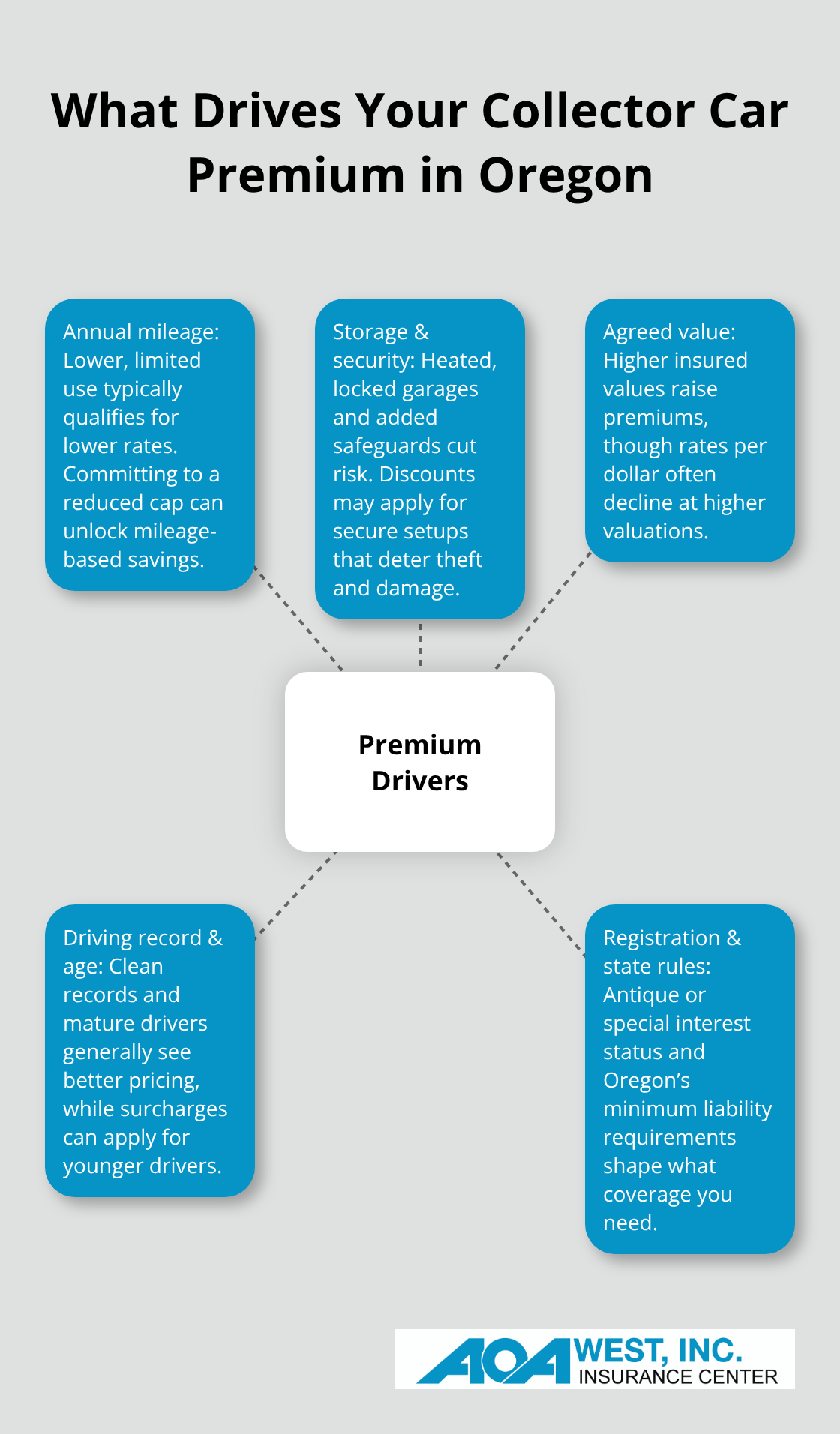
Your driving record and age matter too-younger drivers face surcharges, while a clean record earns better rates. Oregon’s antique registration rules add complexity. Vehicles registered through the state’s special interest or antique program must meet age requirements that shift yearly, and the Oregon DMV sets minimum liability coverage at $25,000 bodily injury per person, $50,000 per accident, $20,000 property damage, and $15,000 personal injury protection per person.
Coverage Limits and What They Protect
Coverage limits on collector car policies vary by insurer, but agreed value replaces the depreciation trap of standard policies entirely. Comprehensive coverage protects against fire, theft, windstorms, hail, and vandalism-critical in Oregon’s climate. Collision coverage is optional but recommended if your car is newer or you plan to drive it regularly to events.
Spare parts coverage typically runs $50 to $150 annually and protects restoration components not yet installed. Roadside assistance ensures your car reaches a qualified repair shop if it breaks down, and TreasureGuard benefits common in Oregon policies include full safety glass replacement and basic towing. The $250 disaster relocation coverage reflects Oregon’s real wildfire and flood risk.
Comparing Policies Across Multiple Carriers
When comparing quotes across carriers, focus on how each defines agreed value, what mileage allowances they permit, whether they cover active restoration, and whether repair shop choice is truly yours or restricted. Rates and coverage structures differ significantly across insurers. Some specialize in American classics, others in European imports or modified vehicles, so matching your car’s type to the right insurer matters as much as the price.
Try to obtain quotes from at least three carriers to see how protection and cost align with your specific vehicle and usage patterns.
How to Choose the Right Collector Car Insurance Policy
Document Your Vehicle’s Condition and Value
Start by photographing your collector car’s exterior, interior, engine, and any restoration work completed or in progress. Take detailed shots from multiple angles to establish a clear baseline of condition. If your vehicle’s value exceeds $25,000, obtain a professional appraisal from a certified appraiser familiar with classic cars in Oregon’s market. This documentation becomes your foundation for agreed value discussions with insurers and protects you if a claim dispute arises later.
Calculate Your Realistic Annual Mileage
Most collectors drive 2,500 to 5,000 miles yearly to car shows and club events, though some drive significantly less. Insurers reward lower mileage commitments with better rates, so state your actual mileage honestly when requesting quotes. If you plan to drive under 2,500 miles annually, communicate that clearly-the premium difference can be substantial. Overestimating mileage costs you money unnecessarily, while underestimating it risks coverage denial if a claim occurs.
Identify Your Storage Setup and Driving Record
Specify your storage location precisely. A heated, locked garage in Tigard qualifies for standard rates, while an unheated shed or carport may trigger higher premiums or coverage restrictions. Document your driving record, your age if you’re the primary driver, and whether you’ve taken defensive driving courses, as these factors directly impact your final premium.
Request Quotes and Compare Coverage Details
Request quotes from at least three different insurers and ask each the same specific questions about their agreed value process, mileage allowances, whether they cover active restoration work, and whether you can choose your own repair shop. Some carriers specialize exclusively in American classics while others focus on European imports or modified vehicles, so matching your car’s type to the insurer’s expertise matters as much as price. Ask each carrier how many collector car policies they wrote in the past year in Oregon, because experience with local regulations and claims handling significantly affects your outcome.
When comparing policies across carriers, examine coverage differences carefully so you understand exactly what you’re getting. A local independent agent in Tigard can explain how Oregon’s antique registration rules affect your specific vehicle and confirm your policy aligns with state minimum liability requirements ($25,000 bodily injury per person, $20,000 property damage). Request quotes online if you prefer speed, but speaking directly with an agent before committing helps you understand coverage nuances and confirm the policy truly fits your situation rather than just checking a box on a form.
Final Thoughts
Collector car insurance in Oregon protects your investment in ways standard auto policies simply cannot. Agreed value coverage guarantees you receive the full insured amount for a total loss without depreciation penalties, while specialized features like spare parts coverage and active restoration protection acknowledge that classic cars require different handling than daily drivers. Oregon’s climate risks-wildfires, floods, windstorms-make comprehensive coverage and disaster relocation benefits genuinely valuable, not optional add-ons.
Start by documenting your vehicle’s condition with photographs and obtaining a professional appraisal if value exceeds $25,000. Calculate your realistic annual mileage and identify your storage setup, since these factors directly determine your premium. Request quotes from at least three carriers and compare how each handles agreed value, mileage allowances, and repair shop selection, asking each insurer about their experience writing collector car policies in Oregon.
We at AOA West, Inc. work with multiple carriers to deliver personalized guidance and side-by-side comparisons so you can choose collector car insurance in Oregon tailored to your specific vehicle and usage. Contact us today to discuss your collector car insurance needs and receive a personalized quote that reflects your vehicle’s true value and your actual driving patterns.
Disclaimer: The information provided in this blog is for general informational purposes only and does not constitute legal, financial, or insurance advice. Coverage options, terms, and availability may vary. Please consult with a licensed professional for advice specific to your situation. Artificial intelligence may have been used to generate text and images in some blog articles.