
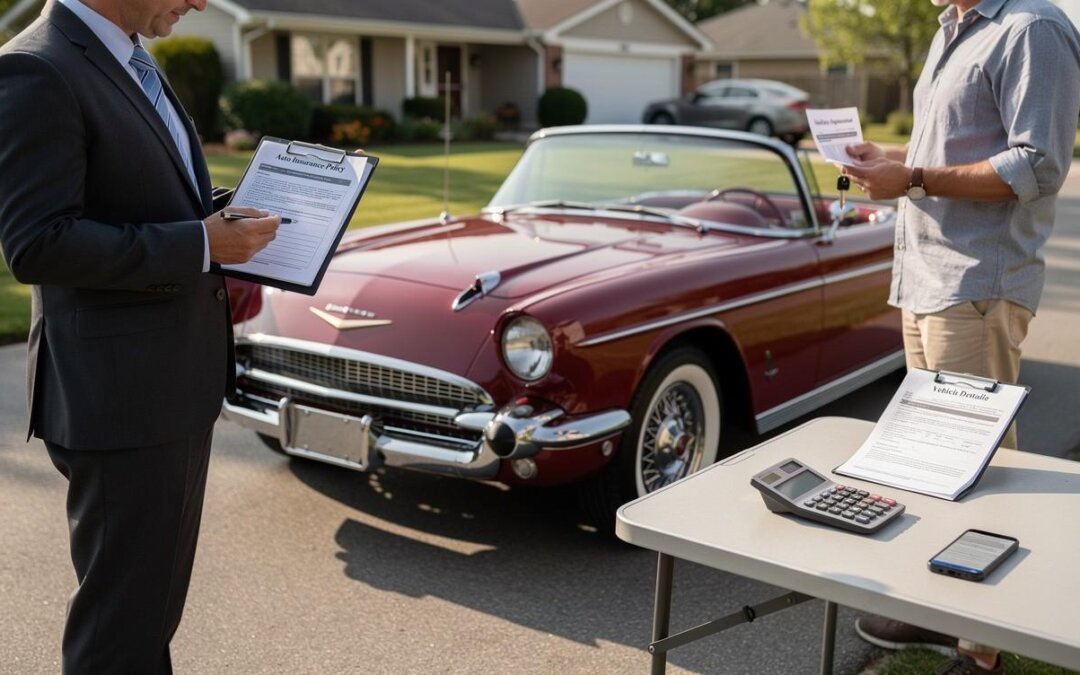
Your vintage car isn’t just transportation-it’s an investment that deserves protection standard policies won’t provide. Collector car coverage in Oregon is specifically designed to handle the unique needs of rare and classic vehicles that appreciate over time.
At AOA West, Inc., we’ve seen too many collectors settle for inadequate coverage that leaves their prized possessions underprotected. The right policy makes all the difference when you’re serious about safeguarding your vehicle’s value.
How Collector Cars Stand Apart from Everyday Vehicles
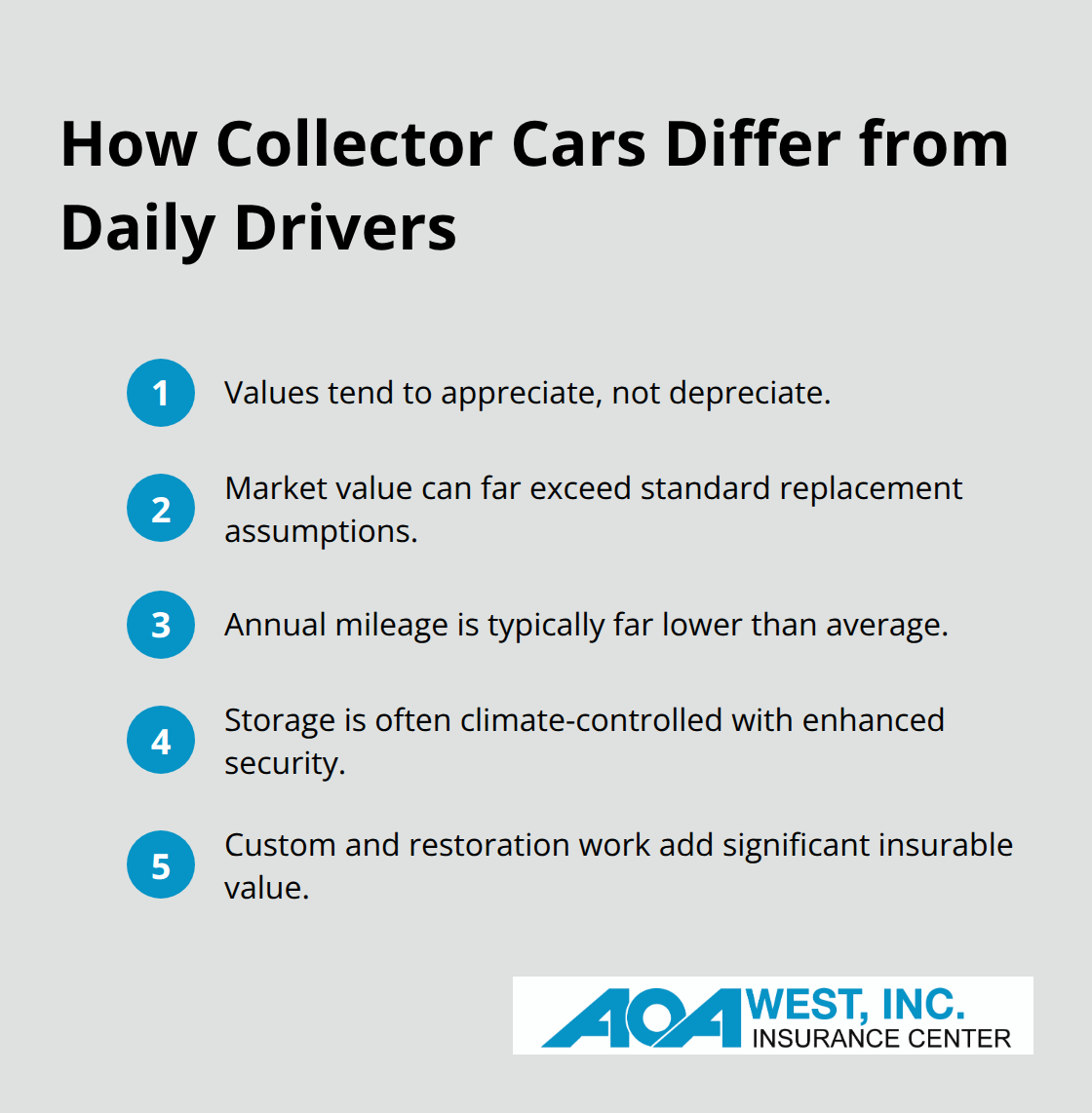
Collector cars operate under completely different economics than standard vehicles, and insurance companies recognize this reality. A 1967 Chevrolet Corvette Stingray that sold for around $4,000 new now commands $70,000 to $100,000 at auction, depending on condition and mileage. These vehicles appreciate rather than depreciate like your daily driver. Standard auto insurance calculates premiums based on replacement cost at current market value, which means an insurer might quote you coverage based on $15,000 when your classic actually costs $80,000.
You’d face severe underinsurance if something happened.
Usage Patterns Reshape Your Risk Profile
The usage patterns differ radically from standard vehicles. Most collectors drive their cars 2,000 to 5,000 miles annually, according to enthusiast surveys, compared to the national average of 13,500 miles per year for regular vehicles. Some vintage owners drive even less-show cars might see only 500 miles per year. Standard policies don’t account for this dramatically reduced risk profile, so you pay premiums calculated for someone commuting daily when your vehicle sits in climate-controlled storage most of the time.
Storage Conditions Matter More Than You Think
Your collector car probably lives in a garage or storage facility designed specifically to protect it, not in a driveway exposed to weather and traffic like standard vehicles. Climate control, security systems, and regular maintenance by specialists become the norm for serious collectors. These conditions substantially reduce risk compared to cars parked on streets or in open lots. Standard insurance treats a garaged 1955 Mercedes-Benz the same way it treats a 2020 sedan parked outside an apartment complex-a fundamental mismatch.
Custom Work Requires Specialized Protection
Restoration work and custom modifications on collector vehicles require specialized coverage that standard policies either exclude or severely limit. If you’ve invested $25,000 in a frame-off restoration or added custom upholstery, standard coverage won’t protect that investment. Oregon collectors need policies that specifically address agreed values, which lock in your vehicle’s worth today so appreciation doesn’t leave you underinsured tomorrow. This protection gap between standard and collector policies sets the stage for understanding what coverage options actually work for your situation.
What Coverage Actually Protects Your Collector Car
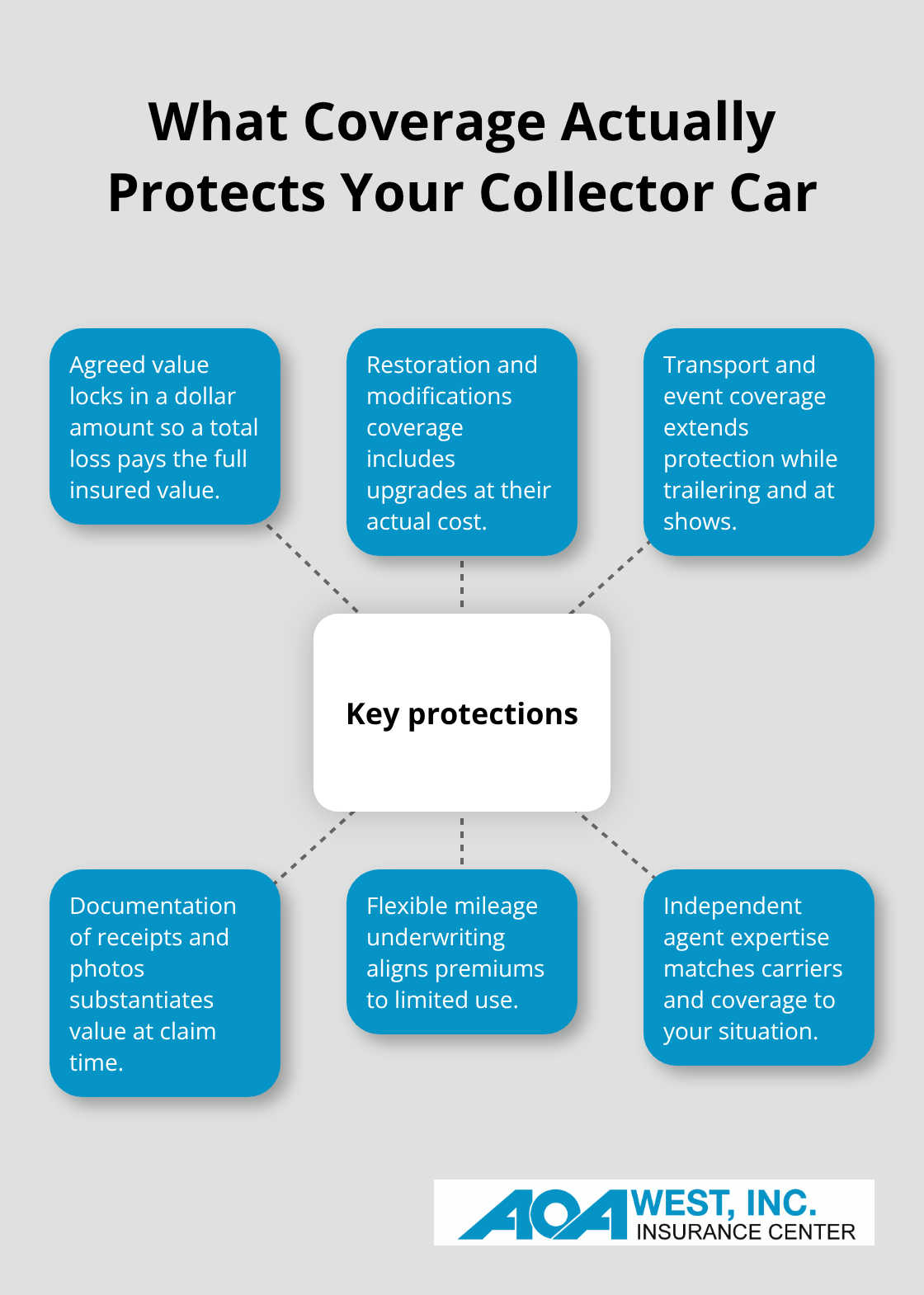
Agreed value policies represent the only sensible choice for Oregon collectors, and we at AOA West, Inc. strongly recommend them over actual cash value options. With agreed value coverage, you and your insurer establish your vehicle’s worth upfront, locking that amount in your policy. If a 1978 Porsche 911 Turbo you insure for $65,000 gets totaled, you receive exactly $65,000, regardless of what similar cars sell for at auction that month. Actual cash value policies pay depreciated amounts determined after a loss occurs, which defeats the entire purpose of owning an appreciating asset.
Many standard insurers push actual cash value because it costs them less, but this approach leaves collectors exposed to market fluctuations and underinsurance.
Restoration Work Demands Explicit Coverage
Restoration work and custom modifications require explicit coverage that standard policies either exclude entirely or cap at unrealistic limits. If you spend $30,000 on a frame-off restoration, engine rebuild, or custom interior, that investment vanishes under a standard policy that only covers the pre-restoration value. Oregon collectors need coverage that specifically includes these enhancements at their actual cost, not depreciated amounts. When you work with an independent agent who understands collector vehicles, they document your restoration receipts and custom work upfront, which ensures your policy reflects the real value you’ve created. This documentation proves critical if a claim occurs, as it provides proof of the work completed and money invested.
Transport and Event Coverage Fills Critical Gaps
Moving your collector car to shows, auctions, or storage facilities creates exposure that everyday auto policies don’t address adequately. Standard coverage often excludes vehicles transported on trailers or limits liability during exhibition events. Proper collector car policies include coverage during transport to car shows, while parked at exhibitions, and during storage periods away from your primary garage. If you trailer your 1963 Corvette Stingray to the Portland Swap Meet or transport it to a restoration shop across Oregon, your policy should explicitly cover that vehicle while in transit and at the destination. Many collectors discover too late that their standard policy won’t pay for damage occurring while their car sits at a show or during professional transport.
Why Coverage Details Matter for Your Investment
The gap between standard and collector policies extends far beyond simple price differences. Your collector vehicle represents years of investment, research, and passion-coverage that fails to protect that commitment creates financial exposure you simply cannot afford. The right policy acknowledges what your vehicle actually means to you and what it costs to replace or restore. Understanding these coverage distinctions positions you to make informed decisions about which protection truly safeguards your investment, which leads directly to evaluating why standard auto insurance falls so short for serious collectors.
Why Standard Policies Undervalue Your Collector Car
Standard auto insurance companies price policies using depreciation tables designed for vehicles that lose value every year. When you insure a 2024 Honda Civic, the insurer calculates replacement cost by subtracting wear and tear from the original purchase price. This methodology collapses completely for collector vehicles that function as an investment vehicle rather than depreciate. A 1970 Chevrolet Chevelle SS worth $35,000 today might appreciate over time, yet a standard actual cash value policy ignores this trajectory entirely. The insurer bases your coverage limit on today’s market value, not tomorrow’s, which means your protection fails to keep pace with your vehicle’s appreciation.
Insurance companies operating under standard underwriting refuse to acknowledge that your collector car functions as an investment vehicle rather than transportation. They treat a rare Mercedes-Benz 300SL the same way they treat a commuter car, applying depreciation formulas that guarantee underinsurance over time. Oregon collectors who accept standard coverage discover this gap only after a loss occurs, when the payout falls thousands of dollars short of actual replacement cost. The financial damage extends beyond the immediate shortfall because you cannot recoup the appreciation your vehicle accumulated while you owned it.
Mileage Restrictions Create Unfair Premium Structures
Standard insurers build premium calculations around national average mileage of approximately 13,500 miles annually, yet collector car owners typically drive 2,000 to 5,000 miles per year according to enthusiast data. This means you pay premiums based on risk exposure that doesn’t match your actual driving patterns. A standard policy charges you as if your 1955 Thunderbird sees regular commute use when it actually sits in climate-controlled storage eleven months per year.
You subsidize risk that doesn’t exist in your situation, which makes standard coverage economically inefficient for serious collectors. Many standard insurers won’t even accommodate lower mileage through premium adjustments because their underwriting systems lack the flexibility to recognize collector car usage patterns. You face a choice between paying full premiums for coverage designed for high-mileage vehicles or accepting inadequate protection. Collector-specific policies, by contrast, explicitly factor in actual mileage and provide premium structures that reflect your reduced exposure.
Coverage Gaps at Shows and During Transport Leave You Exposed
Standard auto policies contain explicit exclusions for vehicles transported on trailers and for vehicles parked at exhibitions or shows. If you trailer your 1963 Corvette Stingray to the Portland Roadster Show or transport it to a restoration specialist across Oregon, your standard policy may not cover damage that occurs during transport or while the vehicle sits at the event. The exclusion language typically states that coverage applies only while the vehicle operates on public roads under its own power.
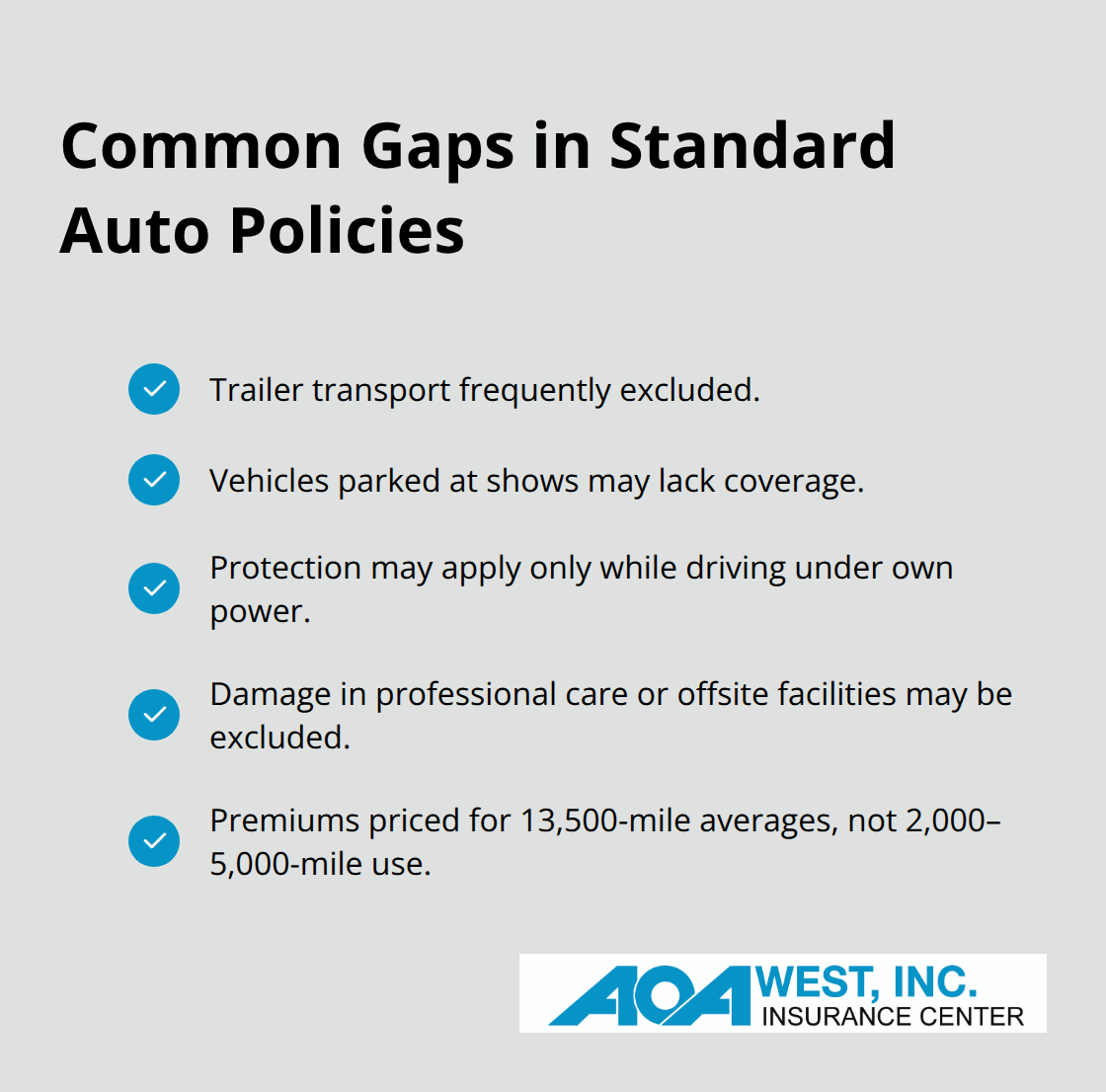
The moment your collector car gets loaded onto a trailer, standard coverage either terminates or severely limits liability and collision protection. Restoration shops and transport companies create additional exposure because standard policies often exclude vehicles in professional care or at facilities outside your primary residence. You could face a situation where your prized vehicle sustains damage during professional transport and your insurer denies the claim based on exclusionary language buried in the policy. Collector car policies eliminate these gaps by explicitly including coverage during transport, at exhibitions, and in professional care situations. The difference between standard and specialized coverage becomes starkly apparent the moment you need to move your vehicle or display it publicly.
Final Thoughts
Collector car coverage in Oregon operates on fundamentally different principles than standard auto insurance, and this distinction matters enormously for protecting your investment. Standard policies undervalue your vehicle, ignore your actual mileage patterns, and exclude coverage during transport and exhibitions. Agreed value policies lock in your vehicle’s worth today, restoration work receives explicit protection, and your car stays covered when you move it to shows or storage facilities across Oregon.
Your collector vehicle represents years of investment, research, and passion that standard coverage simply cannot address. Whether you own a 1967 Chevrolet Corvette Stingray appreciating toward six figures or a restored 1955 Thunderbird with custom modifications, specialized protection acknowledges what your vehicle actually costs to replace or restore. Standard insurers treat your rare classic the same way they treat a daily commuter, which guarantees underinsurance as your vehicle appreciates over time.
Finding the right protection starts with working with an independent agent who understands collector vehicles and the Oregon market. We at AOA West, Inc. work with multiple carriers to compare options side by side, so you understand exactly what protection you’re purchasing and why it matters for your situation. Contact us at AOA West, Inc. to discuss collector car coverage Oregon that actually protects your investment.
Disclaimer: The information provided in this blog is for general informational purposes only and does not constitute legal, financial, or insurance advice. Coverage options, terms, and availability may vary. Please consult with a licensed professional for advice specific to your situation. Artificial intelligence may have been used to generate text and images in some blog articles.